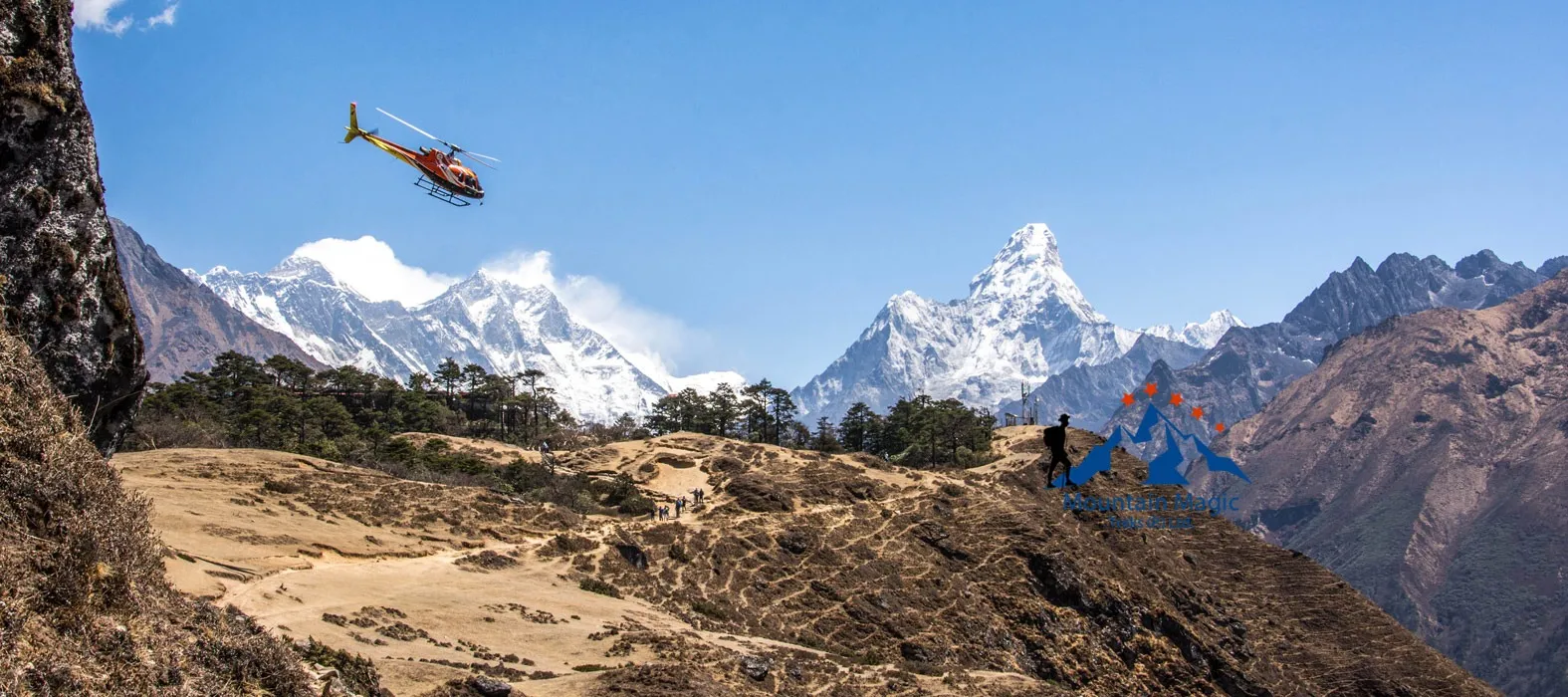
An Everest trek does not begin in a world of snow and ice. It starts much lower, where green hills, forests, rivers, and small villages shape the landscape. Then, day by day, the scenery changes.
That slow change is one of the most interesting parts of the Everest Base Camp Trek With Helicopter Return.
You do not suddenly arrive in a frozen mountain world. You watch it develop around you. Trees become fewer, the valleys become wider, and the mountains begin to dominate the horizon.
By the time you reach Everest Base Camp and Kala Patthar, the landscape looks completely different from the place where your trek began.
The First View Is Not What You Expect
The early part of the journey has a softer look.
After arriving in Lukla, the trail passes through green hills and follows sections of the Dudh Koshi River. Small settlements appear along the route, and the sound of running water often stays close to the trail.
At this stage, Everest can feel far away.
That is part of what makes the journey interesting.
You are not walking straight into a wall of snow. Instead, the landscape slowly prepares you for what is ahead.
Forests Slowly Give Way to Open Land
As the trail climbs toward Namche Bazaar and beyond, the scenery begins to shift.
The forest remains beautiful, but the trees gradually become less dominant. Open mountain slopes start taking their place.
The views also become larger.
Peaks that once looked distant begin to stand out more clearly. The trail feels more exposed, and the surrounding mountains become a bigger part of your day.
The Everest Base Camp Trek With Helicopter Return lets you see this change step by step instead of simply flying over it.
A Change You Can Actually Feel
The landscape is not the only thing changing.
The air becomes thinner as you gain height. Walking requires more care, and your body needs time to adjust.
This is why acclimatization stops at places such as Namche Bazaar and Dingboche are important parts of the trek. The schedule allows trekkers to spend time at altitude before moving higher.
You are not only crossing a distance.
You are moving through several different mountain environments.
The Khumbu Region Starts to Feel Vast
After leaving the lower valleys, the scenery becomes more open and rugged.
At Tengboche, the surrounding peaks create a huge mountain backdrop. The area is also home to the well-known Tengboche Monastery, adding a cultural feature to an already dramatic setting.
Further ahead, the landscape becomes quieter.
The trail around Dingboche has fewer trees and more exposed ground. From this area, trekkers can see major peaks including Ama Dablam, Lhotse, and Makalu in the distance.
This is when many travelers begin to realize how far they have come.
The Landscape Becomes Rocky and Raw
Near Lobuche, the scenery has a much harder appearance.
Green hills are mostly behind you. Rocks, glaciers, and high mountain slopes now dominate the view.
The Khumbu Glacier becomes an important part of the landscape. The trail also passes the memorial area near Thukla, where memorials honor climbers who lost their lives in the Everest region.
It is a powerful place because it adds another layer to the journey.
The mountains are beautiful, but they also demand respect.
Gorakshep Feels Like Another World
Gorakshep sits at a very high elevation and acts as the last settlement before Everest Base Camp.
Here, the environment feels completely different from the green hills around Lukla.
The air is thin. The ground is rocky. The surrounding peaks feel enormous.
From Gorakshep, trekkers continue toward Everest Base Camp before returning to the settlement.
The walking distance may not look huge on a map, but the altitude makes this section demanding.
Reaching the Base Camp Changes the Mood
There is a special feeling when the trail finally reaches Everest Base Camp.
You have spent days moving through changing landscapes to reach this point.
The Khumbu Glacier and surrounding peaks create a dramatic setting around the base camp. Depending on the season, the area can look very different, but the scale of the mountains remains impressive.
This is not simply another stop on the route.
It represents the end of the main climb toward the famous destination.
Kala Patthar Adds Another View
For many trekkers, Kala Patthar is another major moment.
The viewpoint rises to about 5,545 meters and offers a close view of Mount Everest along with other major peaks. The climb is usually made as a morning hike from Gorakshep.
The view from here helps put the entire journey into perspective.
You can see glaciers, ridges, valleys, and enormous peaks spread across the horizon.
After seeing the Himalayas from the trail for several days, the landscape suddenly opens up in a much wider way.
Then the Journey Changes Direction
The Everest Base Camp Trek With Helicopter Return has an unusual ending.
Instead of walking back through the same mountain landscape, you leave the high region by helicopter.
The flight from the Gorakshep area provides an aerial view of the valleys, villages, glaciers, and mountains you have just experienced on foot. The actual flight time can vary with conditions, and the published itinerary notes that the return may include a stop around Lukla before continuing toward Kathmandu.
This makes the ending feel very different from the beginning.
You entered the Everest region slowly.
You leave it from above.
Why This Changing Landscape Matters
The biggest attraction of an Everest trek is often described as the mountain itself.
But the journey gives you much more.
You see several landscapes within one trip. Green valleys become forests. Forests become open slopes. Open slopes become rocky high-altitude terrain. Eventually, glaciers and snow-covered peaks fill the horizon.
The Everest Base Camp Trek With Helicopter Return allows you to experience that complete transition while still keeping the return journey short.
That combination is what makes this style of Everest adventure stand out.
FAQs
How high does the trek reach?
The route reaches Everest Base Camp at about 5,364 meters, while Kala Patthar reaches around 5,545 meters according to the published trip details.
Does the scenery change throughout the trek?
Yes. The route moves from green lower valleys and forests into increasingly dry, rocky, and glacial high-altitude terrain.
Is Kala Patthar higher than Everest Base Camp?
Yes. Kala Patthar is higher than Everest Base Camp and is known for its wide views of Mount Everest and the surrounding peaks.
What is different about the return?
Instead of retracing the trekking route on foot, the Everest Base Camp Trek With Helicopter Return uses a helicopter for the journey back toward Kathmandu.
Conclusion
The Everest Base Camp Trek With Helicopter Return is not only about reaching one famous point.
It is about watching an entire landscape transform as you climb.
Green valleys slowly disappear. Forests become thinner. Rocky slopes take over. Glaciers appear. Giant peaks surround the trail.
Then, after reaching the heart of the Everest region, the helicopter takes you above the same landscape and gives you one final chance to see how enormous it really is.
That change from walking through the mountains to looking down on them—is one of the defining features of this Everest journey.
