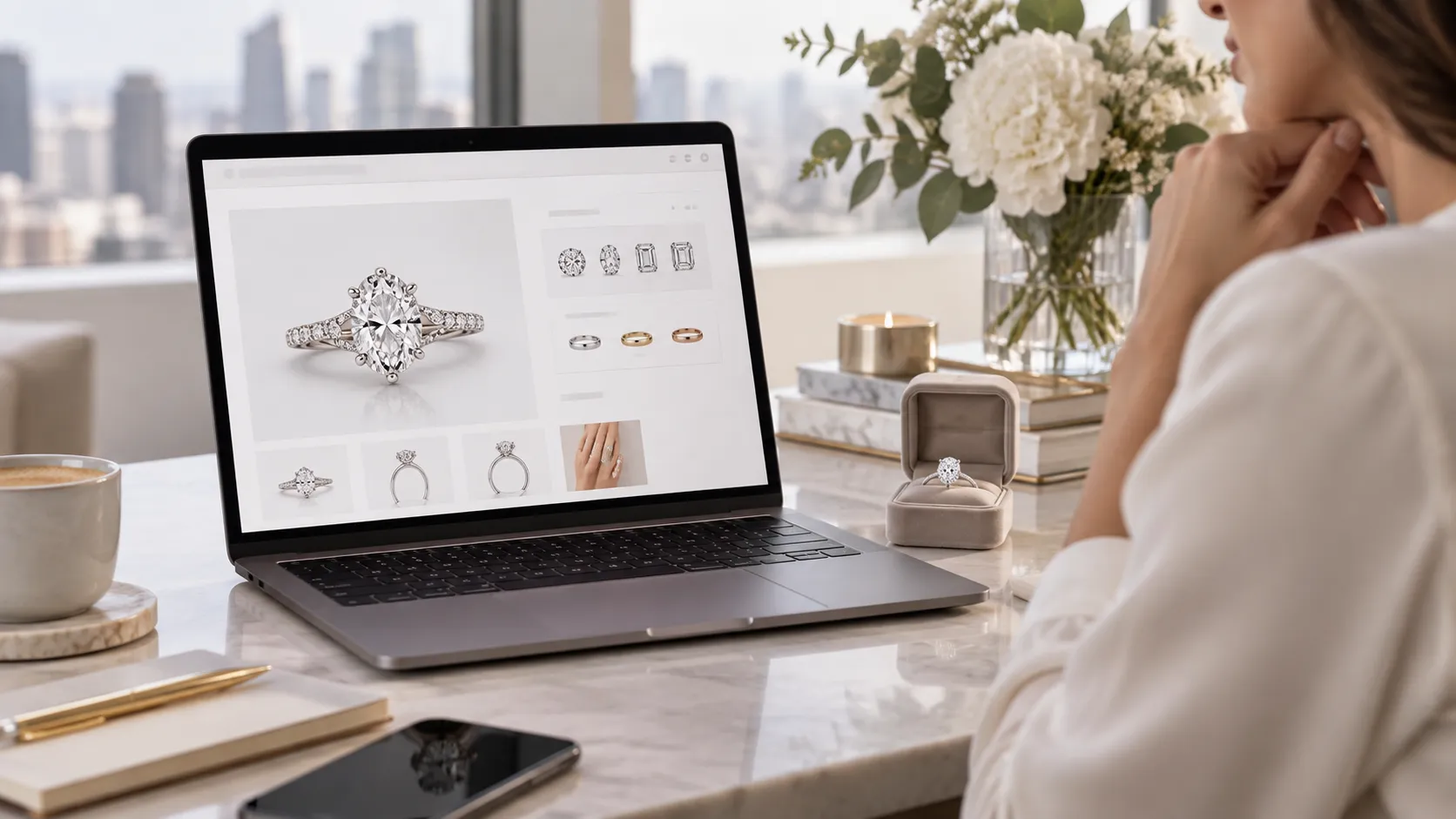
Fine jewellery has traditionally been associated with in-person appointments, glass display cabinets and a relatively fixed selection of finished pieces.
That model is still important, but online customisation is changing the way customers approach jewellery buying.
Instead of choosing only from what is already made, buyers can increasingly personalise the design, compare materials, select gemstones and understand pricing before production begins.
Consumers Expect More Control
Personalisation has become common across many industries.
Customers configure computers, cars, furniture and clothing online, so it is natural that jewellery is moving in the same direction.
For fine jewellery, buyers may want control over:
- centre-stone shape;
- carat weight;
- setting style;
- precious metal;
- band width;
- stone arrangement;
- claw design; and
- overall budget.
This turns the buying process from simple selection into active participation.
Jewellery Is Especially Suited to Personalisation
Jewellery often carries emotional meaning that goes beyond its material value.
An engagement ring, anniversary piece or custom pendant may be worn for decades and become associated with a significant life event.
That makes small design details more important.
A customer may care deeply about whether the centre stone is oval or emerald cut, whether the setting sits low on the finger, or whether the metal is yellow gold instead of platinum.
Online customisation makes these decisions easier to explore.
Digital Tools Make Complex Choices More Manageable
Fine jewellery can be technically complicated.
Customers may need to understand gemstone type, diamond quality, metal purity, setting construction and sizing.
A well-designed online tool can break those decisions into smaller stages.
For example:
- Choose the setting.
- Select the precious metal.
- Choose the centre stone.
- Compare specifications.
- Review the final combination.
This structured process can make custom jewellery feel much more approachable.
Online Customisation Improves Comparison
One of the biggest advantages of digital shopping is the ability to compare several options quickly.
A customer can move between:
- round and oval diamonds;
- white gold and platinum;
- solitaire and halo settings;
- different carat weights;
- different gemstone types; and
- different price points.
This makes it easier to understand which choices actually matter most.
Price Transparency Becomes More Useful
Traditional custom jewellery can sometimes feel difficult to price because several decisions are combined into one quote.
Digital customisation can make the relationship between each choice and the final price much clearer.
A buyer may discover that changing the centre-stone size has a larger impact than changing the metal, or that a simpler setting makes room in the budget for a larger stone.
This helps customers allocate their budget more intentionally.
Lab-Grown Diamonds Fit the Digital Model Well
Lab-grown diamonds are particularly well suited to online comparison because individual stones can be filtered by detailed specifications.
Customers may be able to compare:
- shape;
- carat weight;
- colour;
- clarity;
- measurements;
- price; and
- grading information.
This makes the selection process more transparent and gives buyers more control over the centre stone.
Moissanite Also Benefits From Online Customisation
Moissanite has become another popular choice for customers who want strong brilliance, durability and more flexibility in stone size.
Online tools make it easier to compare moissanite with lab-grown diamonds and see how each gemstone works across different settings.
This is especially useful for buyers who are still deciding which material suits them best.
Customisation Can Be Practical, Not Just Decorative
Personalisation is not only about appearance.
It can improve how the jewellery works in daily life.
For engagement rings, buyers may want to adjust:
- setting height;
- band width;
- claw shape;
- stone protection;
- wedding-band clearance; or
- overall profile.
These details can make a major difference to comfort and long-term wear.
CAD Design Has Changed the Bespoke Process
Computer-aided design has made custom jewellery easier to visualise before production.
Instead of relying only on sketches, customers may be able to review a digital representation of the ring from several angles.
This can help confirm:
- proportions;
- stone placement;
- band thickness;
- setting height;
- side-stone arrangement; and
- overall structure.
Design changes can then be discussed before the piece moves into manufacturing.
Online Does Not Mean Fully Automated
One of the most important misconceptions about digital jewellery buying is that technology has to replace the jeweller.
In reality, the strongest experience often combines online tools with human expertise.
A buyer may be comfortable choosing the style and centre stone independently but still want professional advice about:
- diamond proportions;
- setting durability;
- metal choice;
- stone security;
- ring sizing; and
- wedding-band compatibility.
This hybrid approach gives customers freedom without removing expert guidance.
Couples Can Design Together
Many engagement rings are now chosen collaboratively.
Online customisation makes this easier because couples can compare designs at home without the time pressure of a showroom appointment.
They can save ideas, share screenshots and discuss different options before making a final decision.
This can make the process more relaxed and personal.
Visualisation Is Becoming More Important
One challenge with made-to-order jewellery is that the final piece may not exist yet.
High-quality renders, interactive previews and 3D visualisation can help customers understand the design before production begins.
As these technologies improve, the gap between shopping for a finished piece and designing one online will continue to narrow.
Online Ring Builders Are a Natural Evolution
Engagement rings are one of the clearest examples of how online customisation is changing fine jewellery.
Instead of choosing from a limited range of finished rings, buyers can now start with their own preferences and build around them.
Customers who want to build an engagement ring online can compare settings, centre stones and precious metals before committing to the final design.
This gives the buyer a much more active role in the creation process.
Customisation Can Improve Confidence
A high-value purchase becomes easier when customers understand what they are buying.
Online tools can help explain how individual choices affect:
- appearance;
- price;
- durability;
- maintenance; and
- long-term wear.
This can reduce uncertainty and make the final purchase feel more considered.
The Future of Fine Jewellery Is Likely to Be Hybrid
Traditional craftsmanship is not disappearing.
What is changing is the way customers access it.
Digital tools allow buyers to complete more research and design work before speaking to a jeweller, while skilled professionals remain essential for refining the design and producing the finished piece.
This combination of technology and craftsmanship is likely to become increasingly common.
Personalisation Is Becoming the New Expectation
The rise of online customisation reflects a broader change in consumer behaviour.
People increasingly expect important purchases to reflect their own preferences.
For fine jewellery, this means more control over design, materials and budget without losing the expertise behind the finished piece.
The result is a buying experience that feels more transparent, more flexible and ultimately more personal.